| |
History of the Alavi Bohras:
- The Muslim world follows the directions of Prophet Mohammad (saws) and consider him to be the 'Ultimate Prophet representing the Religion of Allaah'. Prophet Mohammad is the founder of the Islamic Ethics and Thoughts in the hands of whom Islam became a complete Code of Conduct for Muslims. The seat of Daw'at (religious organisation) was in Yaman before 500 yrs back. The Bohras used to dwell there. Then the Bohras migrated from Yaman to Ahmedabad and then to Baroda. They are in Baroda since 320 years. Unrestful conditions backed by political conpiracies was the reason for the Alavi Bohras to migrate from Ahmedabad to Vadodara
- The 32nd Da'i-e-Mutlaq, S. Ziyauddin Saheb took along the Alavi Bohras and migrated from Ahmedabad to Vadodara in 1700 AD. Seeing the devotion and simplicity of the Alavi Bohras towards their religion, Miya Mahmud, a Shi’a by religion gifted the Wadi area to the Da’i to establish Madrasah, Mosque and Houses. It was the place from where fruits, flowers and vegetables were supplied to the then ruler of Vadodara.
- The Alavi Bohras can be said to be the oldest dwellers in Vadodara.
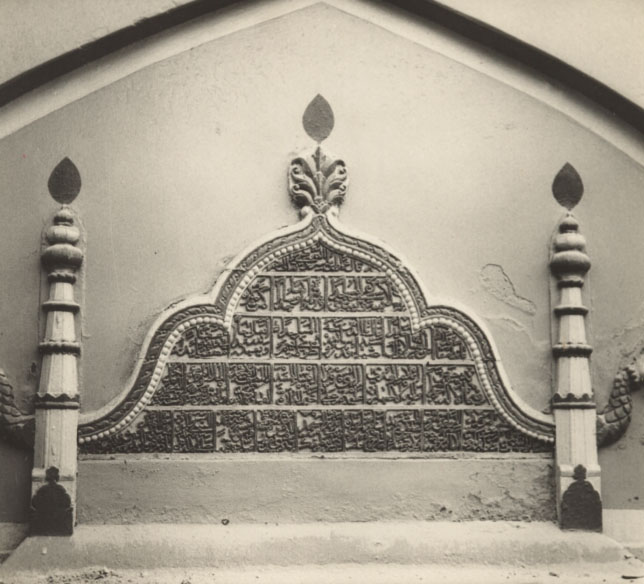
- The 32nd Da'i-e-Mutlaq, S. Ziyauddin Saheb has his grave in the Wadi area of Vadodara who died in 1718 AD. The Mausoleum of this Da’i has the graves of 6 other Priests-Da’is along with his situated in Maru Falia. The incription of the tomb of a Da’i carries the date of his death as per Misri Calendar, name of the Head Priest along with Qur’anic Verses.
- There are 11 missionary tombs in Vadodara, the highest among Bohras located at one single place having the history of their mission spanning through 3 centuries. The tomb at Maru Falia having 7 graves under two magnificent domes is supposed to be the oldest in Vadodara. The place is used for burial since 1718 AD.
- When the mosque al-Masjid un-Noorani situated at the corner of Badri Mohalla, Wadi, was completed in 1973 AD after six years of construction, the skyline of Vadodara city was very low. There was much of a philosophy of single-double storied construction. The Gaekwadi Laxmi Vilas Palace and Nazarbaug Palace was clearly visible from the Mosque’s terrace.
Culture of the Bohras:
- There is a difference in the tradition and culture of the Alavi Bohras from the general Muslims. A Bohra usually does not go to other mosques other than a Bohra mosque to pray as it is not made sacred by his Da’i but if he does, he prays in his own Bohra style as he does in his own community mosque.
- A Bohra mosque is different from the other mosques. Unlike the other mosques, ladies are allowed to enter in the mosque premises and pray along with the gents. A Bohra mosque also does not have a Mimbar which is an essential element of a Mosque as their Imaam is in the state of Concealment known as Sater. Rather, the priest teaches the prayers sitting on the Masallah (praying mat). The General assemblies-majlis are done facing the Da'I while Namaaz is prayed facing the Qibla (west direction) where Holy Ka’bah is located.
- In the early times of Islam, the grandson of Prophet Mohammed, Imaam Husain went to Karbalaa and was martyred there. In the memory of his martyrdom, Bohras converge in a mosque and pray from 2nd-10th Moharram in which the general Muslims take out Tajiya. The Bohras do not believe in Tajiya. The 10th moharram is Aashura, the day of Martyrdom when Bohras mourn and do Ma’tam in the Masjid in front of the Pulpit of Da’i. The Pulpit-Takht is always kept in Masjid and Saiyedna ascends on it whenever Bohras assemble in Masjid for the prayer of Auspicious day/night.
- In Bohras, there is a tradition where the people come to their Saiyedna-Da'i (priest) and kiss his right hand and leg as a symbol of respect for him as they have faith that the Da’i is in the place of the Prophet under the feet of whom is a Paradise. At the time of Majlis or spiritual ceremony, people do not sit directly, but they stand and bow three times looking at their Da'i denoted as Salaam. Then the Da'i looks at them, accepts their respect and this is a sign of the permission by him to sit.
- Masjid-Mosque is a place where a believer Bohra bows down for his Lord-Allaah, so it is considered the most holy and sacred place and has an important role to play in the life of a Bohra.
Establishment:
The propagation of Islam by the Prophet started in Mecca, but the 1st mosque of Islam was built in Madina and the rest of the Muslim World followed its example. When the Bohras came to Vadodara there was a single mosque near Gendi Gate built in the time of 26th Da’i where Alavi Bohras prayed.
Primarily, the Bohras dwelled in the Wadi area which had its peripheries right from Jahangirpura to Pratapnagar earlier. Then by the passage of time, the population increased and some people started migrating from old city areas to new ones namely Ajwa Road. Now in Vadodara Alavi Bohras have 4 mosques in different areas.
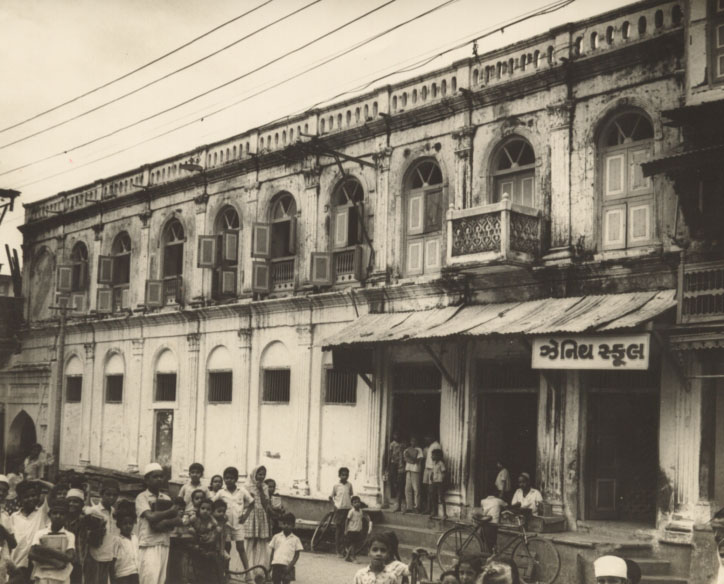
The old mosque in the Badri Mohalla, Wadi was constructed by the 32nd Da’i before 300 years but now at the same place stands the new Noorani Masjid built at the time of 43rd Da’i. The 44th Da’i Saiyedna Taiyeb Ziyauddin saheb who is the present holy missionary of Alavi Bohras is the custodian of this mosque. The old mosque was having the following features:
-
The Qibla had gold written Qur’anic inscriptions on wooden plates.
-
Precious wooden inscriptions over the Mihrab were a prime feature.
-
An outer wall with a huge thickness with small minarets.
-
A school inside the mosque called Zenith school.
-
A water tank below the mosque which was almost as huge as the mosque itself used for doing Wuzu
-
In the middle of the mosque there was a big courtyard where Da’i used to assemble people for Majlis.
Construction:
The Bohras have a different concept of mosque construction than the general Muslims. The Alavi Bohra mosque which exists in present was constructed on the foundations of the earlier mosque from 1966 till 1972 AD by the 43rd Da’i Saiyedna Yusuf Nooruddin Saheb. The planning when the mosque’s construction was about to begin was to use the outer wall of the earlier mosque for the construction of it. But that was not materialized the engineers and the whole mosque was demolished stage-wise. The construction was completed in 1972 and was inaugurated 15 December 1973 AD.
-
The earlier mosque had a water tank which was as deep beneath the ground below the masjid courtyard as the structure above. When the old mosque was demolished, all the remains, rubbles, iron scraps, were thrown in the water tank beneath the mosque, but still the tank did not get full.
-
The new mosque made 43 years ago is supported on steel-girders which were specially imported from TATA steel company in Jamshedpur, Kolkata. The steel girders from Kolkata were brought in parts and welded here by the workers from there itself. The whole mosque is supported on the steel girder which enables one to get a huge praying hall with a span of 66 by 99ft having a triple heighted roof.
-
Makrana is a place known for its marbles. It had mines of marbles which have gone almost a km deep inside the earth. The marbles used in the mosque were brought from this place.
-
The slab of the existing mosque is approximately 3 feet thick which has a false ceiling layer below made of P.O.P and steel girder with a layer of RCC above it. It is known as Waffle slab in architectural terms.
-
The wood used in the mosque is Malabar wood.
-
The fins (flying buttresses) were made to hide the steel girders below.
-
There is a massive domed structure in the mosque.
About Mosque and its Architecture:
The mosque was made keeping in mind the Islamic Architecture and Culture with religio-social aspect and to blend it with the modern era. There are certain features in the mosque which have a Gothic architecture style influence. An exquisite example is the 'flying buttresses' seen in the elevation of the mosque.
- The mosque does not have an ablution pond like the other mosques. It as an overhead water tank system and there are taps for ablution inside the mosque which decreases the maintenance of the pond.
- The first floor is specially reserved for the Ladies to pray. It has a parapet which has jalis so that the ladies can see the 'Imaam' while praying. The jalis in the arches are made which filter light in an aesthetically appealing way. These jalis are seen in the upper floors on the outer wall.
- There is a huge chandeliers accompanied with two other in the triple heighted praying hall which is a marvelous example of beauty.
- There is a Madrasa (Islamic school) on the second floor of the mosque. It has unique pattern of false ceiling and the entire floor is divided into different classes where pupils are taught Qur’an-reading and memorizing, Community language, Namaaz and Purity, Customs and Practices. Pupils learn different chapters of Qur’an with its understanding and apply it in their daily prayers. Madrasa run at two different times viz. Morning & Afternoon.
- On the west of the masjid there are shops and two-storied houses of Alavi people. The mausoleum of the 43rd Da’i is in the North-East side. North-wards is the mosque of the non-Bohras besides Jamaat-khaana. On its east is the houses of Badri Mohalla which is occupied only by Alavi Bohras. South comprises of the entire Wadi area with Clock Tower and there is the Tomb of 7 Da’is known as Bustan-e-Badri in Maru Falia.
|





.jpg)
.jpg)
.jpg)
.jpg)
.jpg)
.jpg)
.jpg)
.jpg)