| |
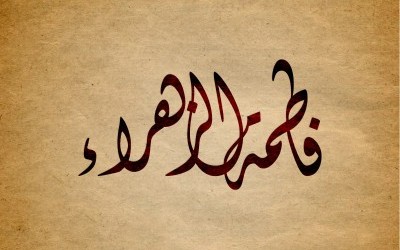
Maulaatona Faatemah
Zahraa’s life speaks of many events from which many morals
and admonitions can be learned, and through which one can familiarize
himself with the true believer’s lifestyles.Allah Subhanahu
bestowed Ma Faatemah with a vast share of greatness and a high levelof
majesty, which no other woman can ever claim to have reached. Her
proximity to Allah can be judged from the greatness that was acknowledged
by Heaven before the creation of mankind; and in whose regard verses
from the Quran were revealed that are and will be read day and night
until the day of Judgement. Ma Faatemah is a lady, who as mankind
advances in the understanding and realization of facts and secrets,
the greatness of her personality will become more apparent, and
the deep meanings of her actions will be more appreciated.
She is Faatemah Zahraa (A.S.) whom Allah praises, and is “satisfied
with her satisfaction, and is angered when she is angered ”.
Imam Jafar us-Sadiq (A.S.) said : “Ma Faatemah (A.S.) has nine
names near Allah Ta’ala, they are: Faatemah (she who safeguards
believers from evil), Siddiqa (the honest), Mubaareka (the blessed
one), Taher (pure, virtuous), Zakiyya (the chaste), Raaziya Marziyya
(she who is gratified), Muhaddesa (a person, other than a prophet,
that the angles speak to) and Zahraa (the splendid).”
Maulaatona Faatemah Zahraa (A.S.) - the beloved daughter of Rasoolullaah
(S.A.W.) and the consort of Maulana Ali (A.S.) exalted in eminent
qualities of honour, nobility, leadership, piety and Allah’s
fearfulness. She radiated beauty and eminated knowledge through
her faith, divine grace and her progeny. She was an institution
of an ideal womanhood.
Ma Faatemah, as the mumineen fondly call her, was destined to be mother
to ‘Aimmat Tahereen’ and ‘Duat Mutlaqeen’.
The ‘Dawat’ today is known by her “mubarak”
name - “Fatemi-Dawat”.
Her birth was to change the status of the woman,whose prior to Islam
was considered inferior to man.Infact the earlier Arabs were so
ashamed of daughters that they used to bury them alive or drown
them in the milk.With the advent of Islam and birth of Ma Faatemah
, women were given exalted and respected position in an Islamic
society. Rasoolullaah (S.A.W.) had described women as ‘wazirs’
in the home and without them the home could not be called a complete
home. Our beloved Nabi has taught us that the ‘zeenat’
of a home was woman who plays a pivotal role in the education and
the upbringing of children. Islam has given her such a high position
with all safeguards for her rights and respect for her virtues.
After Rasoolullaah attained ‘Nabuwat’ and visited the
heavens ‘Jibraeel’ (A.S.) gave him a “Jannat nu
Tuffah” (an apple) which he ate and there after Maulaatona
Faatemah was conceived in the rehm mubarak (womb) of Maulaatona Khadija.
Ma Faatemah had the grace, beauty and fragrance of the “Hur-ul-Een”
of “Jannat” . When Maulaatona Faatemah was born, the heavens
shined gloriously and the whole Mecca glittered with heavenly blessings
and Rasoolullaah (S.A.W.) said that she is the ‘saiyyeda’
(leader) of the women of the world. Rasoolullaah (S.A.W.) had held
Maulaatona Faatemah in such high esteem , that upon her arrival Rasoolullaah
(S.A.W.) would stand up as a mark of love and respect. Even the
‘Farishtas’ take pride in her because of her graceful
qualities.
The mubarak aqd (marriage) of Maulatana Faatemah with Maulana Ali
was destined to happen and infact Allah had blessed their wedding
in heaven.
The wedding of these two eminent personalities was an example to
behold as it set the guidelines to all wedding ceremonies in Islam.
Islam had made it easy for one to get married so that it is not
a burden on it’s followers.
Maulana Ali only had a sword (zulfiqar) and armour (bakhtar) to
offer for ‘mehar’ to Ma Faatemah. Rasoolullaah (S.A.W.)
accepted only the armour as he knew that Maulana Ali would need
Zulfiqar for ‘jehad’, protection of mumineen and expansion
of Islam. The armour was sold for 480 dirhams and the money was
used to buy atar, clothes and some essential household goods. On
the wedding night, Maulaatona Faatemah was taken in a procession to
Maulana Ali’s house, on Rasoolullaah’s ‘utnee’
(she-camel) which was covered with a ‘chatai’. Rasoolullaah
(S.A.W.) together with Hamzah, Aqil and the Banu Hashims followed
along side with swords. Also in the procession were daughter of
Abdul Muttalib and the women of Muhajirin and Ansars. On arrival
at Maulana Ali’s residence, Rasoolullaah (S.A.W.) sprinkled
‘shifa nu pani’ on the bride and groom and then offered
dua for both of them.
Maulaatona Faatemah fulfilled her obligations as a wife and mother
with such ‘shaan’ that it was a great example for all
women. She considered her children as Allah’s “azeem
amanat and nemat” and spent night and day nurturing Maulana
Hasan, Maulana Husain, Maulaatona Zainab and Maulaatona Umme Kulsum.
In her 8 years of marriage she never complained of destitution or
poverty. But to the contrary she was always humble and obedient.
Maulaatona Faatemah was also noted for her ‘pardah’. She
observed it so strictly that she would not remain without ‘pardah’
even in the presence of a blind man. She would do the household
chores all by herself. But her ‘shaan’ was so great
that Jibraeel would come and help her, and the Farishtas would sweep
her home, grind the wheat and assist in swinging the cradle of Maulana
Hasan and Maulana Husain.
Maulaatona Faatemah performed ‘Ibaadat’ with great ‘Ikhlas’
both in ‘zahir’ and ‘batin’. Her prayers
were always answered. There is a ‘riwayat’ that once
her household went without food for three days. On the third day
Maulana Ali obtained some money but on his way to home he met Miqdad
who was hungry for four days. Maulana Ali gave him the money because
he felt that Miqdad was in greater need of it. Such was Maulana
Ali’s ‘sakhawat’ (generosity). The same day after
‘magrib namaaz’, Rasoolullaah (S.A.W.) decided to do the
‘iftari’ in Maulaatona Faatemah’s house. With this
sudden decision both Maulaatona Faatemah and Maulana Ali were distressed
as there was no food in their house. Nevertheless Ma Faatemah prayed
to Allah to safeguard her household’s honour and her prayers
were answered with a ‘thal’ full of ‘maaedat’
(jaman) from heaven. Such was Ma Faatemah’s “shaan”.
Sadly, very sadly, after Rasoolullaah’s (S.A.W.) “wafat”
his beloved daughter and her family were subjected to much “zulm-o-sitam”.
Once Maulaatona Faatemah described the ‘zulm’ such that
if a similar ‘musibat’ were to befall upon the day it
would become a dark night. She grieved and wept day and night upon
the ‘wafat’ of her father. Despite this tragedy she
was patient in her suffering and prayed for ‘mumineens’
of all times to be forgiven.
Maulaatona Faatemah who is also the ‘mamsoolah’ of the
night of 23rd Shehre Ramzan passed away exactly 70 days after the
demise of Rasoolullaah (S.A.W.) at the tender age of18 years. Maulana
Ali was greatly stunned by the sudden loss of his faithful partner
whom he described as the pupil of his eye.
May Allah shower Maulaatona Faatemah Zahraa with “salawat”
and “salam” and grant us the “taufiq” to
follow the foot-steps of this ‘khatun-e-Jannat’ who
now rests peacefully in “Jannat-ul-Baqi” Madina. |